Showing posts with label Facebook. Show all posts

Thursday, August 11, 2022

Data for META Post: Pew Research Center Report Link and Comments

Additional data on teen use of social media apps. This is a follow up to yesterday's post on Meta.

The pdf of the Pew Research Center report "Teens, Social Media and Technology 2022" released on 8/10/22 is available here

My notes:

1. I believe the predecessor of TikTok was musical.ly. I didn't see that mentioned in the Pew study. 
2. Only those ages 13-17 were polled, not those who reached the age of majority.
3. Several services that were in the prior 2014-15 poll no longer exist. These include Vine and Google+.
4. The number of teens who use Facebook "almost constantly" is 2%. Not having seen the report yesterday before my post, this subtlety obviously was not considered. You might see this as a possible source of expansion for Facebook (from 2% to 100% is a 50x multiple!). But I think it is a clear sign that Facebook is on the way out.
5. The number of teens who use any one service "almost constantly" is 19% or less, with YouTube most popular. If we assume that usage "almost constantly" is mutually exclusive, then we can add the amounts for each service:

YouTube  19%
TikTok  16%
Instagram  10%
Snapchat  15% 
Facebook  2%
total  62%

This leaves at most a 50% gain in teen use from current levels. 
6. It's probably the case that perceptions of what teens use lags, as it certainly does for this writer. I had not tracked that Facebook use among teens had fallen so far, or that Instagram was poised for further retreat among teens.
7. It's useful to notice just how much turbulence there is in social media choices overall. The only platform that shows long term stability is YouTube. DCF modeling of income from social media should use shortened durations of earnings.
8. Only 32% of teens "ever use" Facebook. This is a significant decline. It matches what has been said about Facebook before in other places, and it's old news that adults crowded into Facebook to such an extent that it became uncool. I'm in danger of being seriously uncool just mentioning such horribly stale information.

Wednesday, August 10, 2022

Meta's Reality Problem

Mark Zuckerberg is convinced that ordinary message-based communications using text and images will be largely replaced and supplanted by virtual reality in the future. He believes it so hard that he has pivoted his entire company towards delivering the hardware and software needed to create virtual worlds that people might inhabit and interact in. He changed the company's famous name, and its two-letter stock symbol.

It's sometimes amusing, and sometimes appalling, to watch how companies that succeeded at a ground-breaking new technology or product attempt to make lightning strike again in other fields. You've seen it too. Lotus created 1-2-3, then squandered most of its lead in spreadsheet software by attempting to reshape other markets. Google became Alphabet, because even though it controls search, it thinks it is smart enough to re-shape humanity in a half-dozen other ways too, from AI to self-driving cars to desktop software, none of which make any money, since the only lightning strike that Google actually has is search. In contrast, companies that stayed in their lane last longer. Ford Motor Company is still here and still a leader 120 years after it was founded. 

Facebook, having conquered most of the social media world, has decided that it is not good enough for the 21st century? This seems like a mistake. After all, what is wrong with text? It's concise, easily constructed and consumed, and occupies very little storage space. Though slightly less efficient, the same remains true of images, even if they are electronic.

Perhaps I am too old to understand the appeal. But then, I've experienced virtual reality, many years ago. A friend in Los Angeles who is well known in the VFX business showed me his state-of-the-art VR rig in 2016. It was good enough to give you a heart-stopping fear of falling off of virtual "cliffs". It was immersive, high resolution, smooth, without any flaws. It was a very effective demo, one that should have been impossible to dismiss.

And yet, there are problems, all centering on our humanity. If you watch someone in VR with a headset on, you see someone who is disconnected and completely divorced from the world around them. They haven't been enhanced, they have been removed

It reminds of me of a time in the 1990s when I looked through all of the industry categories that Investor's Business Daily maintained. Along with lists of companies, I recall seeing the industries' collective stock rates of return over a long period. It might have been only 10 years, but it was long enough that I felt I was comparing the fundamental prospects of entire industries side-by-side. What emerged was the sense that companies that deal with products that have fundamental human benefits do well. One industry that hadn't? Alcoholic beverages. Over the short run users may derive from enjoyment from the product, but over consumption is detrimental and so the alcoholic beverage industry's best customers tend to curtail their own productivity, and therefore ability to pay.

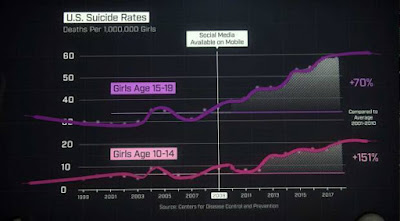
One could argue that Facebook is also such a product. Studies have shown that self-esteem declines among those who are heavy users of Facebook. Teenage suicide rates have increased markedly since the introduction of the smart phone and wide adoption of Facebook and Instagram[1]. The META officers like their products because they can make them addictive while sucking highly personal information from users, and that means higher advertising revenues for META. Perhaps Zuckerberg sees VR as an even more addictive social media. If so, I would worry that it is more like an alcoholic beverage than it is a medicine.
I actually own a few shares of META. It's not much, and so far I'm losing money. I don't see META-based VR as improving the fortunes of its users or of META, and for that reason I have little interest in adding to my position. Normally I would do a discounted cash flow (DCF) analysis of a company in figuring out its long term potential. Unfortunately, tech companies tend to have volatile, short, hard to predict life spans. Will META last five more years before seeing revenues decline? Will they spend all of their profits on VR capex for the next 10 years? At what point would they give up, or would they ride it all the way down to zero? Will it turn out like AOL?

META is already trading at a non-unicorn price. PE of 13.97, at today's price of $178.78. That's not bad, until you see ALLY at PE of 4.6, INTC at 7.4, WBA at 6.6, C at 6.6. Can META grow? Don't they already have 2 billion users? Does the bull case for META involve rooting for people to have more sex and more babies, and a higher total fertility rate (TFR) worldwide?

Teens already spend too much time on Facebook. Just today WSJ published "More Than a Third of U.S. Teens Are on Social Media Almost Constantly, Survey Says". What is the growth rate over "almost constantly"? Is it "constantly" (!!), "while sleeping too", or do we need to rely on increasing Facebook use among prison inmates and finding more undiscovered African and South American tribes?

On the other hand, Facebook and Instagram do seem to addict a lot of people. Look at how that worked for the tobacco companies. All these years later, despite huge price increases and taxes, and the fact that federal, state, and local governments make more money from cigarettes than shareholders do[2], PM, MO, and BTI are still around. Unfortunately for META shareholders, there haven't been enough academic studies that show people dying from use of social media for the liberal hue and cry to go out about shutting down or heavily taxing social media. Fortunately for META shareholders, it is unlikely that such things will come to pass, as liberal sociology academics have normative principles that align with the heaviest user base of social media, which is liberal. It is unlikely that those who lean left will shut down an addictive product most heavily used by the left.

And that bookends the META reality problem quite nicely. Here I will define a "social world" as being one that is held collectively in the minds of a large number of participants. META's infrastructure supports social worlds of this type. The maintenance of a larger, more connected and involved social world is what social media is all about. We've had social worlds since the first clans. Any polity has some aspect of a social world to it. Until 2010, most of our social worlds had to live within physical worlds, and if there was a conflict, usually the physical world won. And in cases where the social world won completely, the precarious physical existence of the polity supporting the social world (e.g., U.S.S.R., East Germany, Mao's China) forced the death or rapid reconfiguration of the "victorious" social world.

Zuckerberg's political style is clearly of this stripe. Perhaps in his mind, collectives can provide better support to a social world when the technology is enhanced. To make something up, he might believe that socialist systems don't fail because of their physical world problems, but because the social worlds built on top of the physical layer wasn't compelling enough.

Said this way, it's obvious that he is constructing a fantasy that is unlikely to hold up. Even when social worlds were held together by single page newspapers, Jane Austen novels, and town marketplaces, they were still vibrant and worthwhile, even though thinly spread. We're richer now by far, but just because we have surplus resources to commit to commentary, outrage, and Like buttons doesn't mean that we make our social worlds richer because of excess.

I think that eventually META will build a virtual world, it will have inhabitants, there will be news articles, and some exciting things will happen there. But it will be like Second Life. It will be like the other Corporate experiments with virtual worlds and virtual meeting spaces, many of which have been attempted and discarded or written off. It will be far less compelling as part of a full life. It will be easily bypassed, too expensive in all sorts of non-monetary ways. There will be injuries, repercussions, and lack of revenue. It will muddle along and be disappointing, but not when you look closely. It will also be exciting when viewed at the small scale, but a distraction when viewed at the scale of civilization.

References

  1. The CDC data on teen suicide I found only goes to 2015, but the graph is certainly cheerier than the ones Jon Haidt uses, in part because it doesn't go out to 2017, and the 1990s were evidently a very dark period for teen males, who committed suicide five times more often female teens.
  2. Federal cigarette tax is $1.01 per pack. State taxes vary, with DC, NY, and CT having the highest rates at $5.01, $4.35, and $4.35 per pack respectively. 

Thursday, October 20, 2011

Emergence of the Real Chronoscope

In 1956 a story by Isaac Asimov was published in Astounding Science Fiction, titled "The Dead Past". The story, ostensibly about Government control of acadamic research, is also a horror piece in which privacy is effectively destroyed through the invention of the chronoscope, a device that can look into the past. And since five minutes ago is the past, that means the chronoscope can see everything.

We are quickly headed toward that future, in which there is no privacy because all of the details of anyone's life, actions, beliefs, acquaintances, and shortcomings can be known by anyone else, anywhere in the world, at any time. Exhibit #1 is Facebook, which is suspected of or has been discovered keeping "shadow profiles" on pretty much everyone on the planet. It doesn't matter whether you have a Facebook account or not. They have a file on you anyway.

And it is a very, very deep file indeed. People who have used a legal option to obtain copies of the data Facebook maintains on them have received 1000-page documents, and that is after redaction of data that Facebook claims is trade secret. Typically, when these Facebook-is-up-to-no-good stories appear, there is a rash of people who defend Facebook, saying that it was the fault of the Facebook users for using the service, but this time the tenor of the dialog is different.

While internet stalking, by neighbors, ISPs, criminals, police, or whoever, is creepy, there have been proposals in the United Kingdom to make the contents of all computer subject to police inspection at any time. Separately, EU MEP Tiziano Motti of Italy has proposed that black boxes be installed on all computers so that police can detect criminal activity automatically. Clearly, given the nature of computers that means that each hard drive would be an open book. And given the nature of mankind, that means the contents of each hard drive would then be available for sale on the black market.

Exhibit #2 is the evolution of face recognition algorithms that can attach names to faces in a photo of a crowd. Depending on which software, company, interest group, or programmer you speak to the current rate of success is anywhere from poor to scary. Google has built facial recognition into Picasa, and claims to have backed off on some uses of the technology on the web because it was scary. The Carnegie Mellon lab that developed PittPatt has been acquired by Google. Facebook has put facial recognition into its software to help people tag others in their photographs. Governments use face recognition at customs to save time spotting terrorists and miscreants. With the proliferation of cameras on city streets, the low price of cameras, and the rapidly declining cost of processors to perform facial recognition on video streams, it is conceivable that real-time citywide monitoring of citizen locations is not very far off.

So whether you are an introverted stay-at-home computer user, or an extroverted on-the-go social butterfly, the future is clearly heading in the direction of keeping close tabs on everything you are doing, whatever its religious or political leaning.

In July, my comment about reputation shredding mentioned a reliance on anonymity for bad actors to cause damage to people falsely accused. With sufficient surveillance and the preponderance of public opinion on your side, however, you wouldn't need to be anonymous at all, because you would have the approval of the majority, and being mean to people isn't against the law.
-------------
For those who are interested, here are some links to materials about The Dead Past.


IMDB entry about the BBC dramatization of the short story (part 1 of 7):

Wednesday, October 12, 2011

Social Media Websites are Designed to Spill

And when they spill, what they spill is their users. As in, dumped on the sidewalk, dumped in the street. Because what people really want from a social network is dirt on other people. And who better to supply than the individual to be dirted upon?

Now, Facebook and Google+ realize that if you believe that your dirt will be publicized, then you might hold back your dirt. So they go to some length to make you believe that your information is in control. Yes! You control your information! Just move the magic slider or click the magic button, and your dirt will be carefully contained where only your friends and acquaintances out to two degrees of separation will see it.

Ah, so when I spotted this item, I knew I had to make the point here at Vorpal Trade that social media is a complex beast and that it will burn a great many people, such as those who develop it.


If a Google engineer can't keep his settings straight, then why would all the rest of us be able to?

Software is complex. Unlike physical reality, the landscape in a software application, and especially web-based applications that Google prefers, changes at the whim of the developer. A "user" of the physical world gets used to things: gravity, light, physical obstacles, the need to eat. Adults are experts at knowing how things work. They aren't surprised when rocks are heavy, trees block your view, or wood rots when exposed to water.

But place mortal humans inside the shifting landscape of a social medium, and they aren't quite so capable. And since it is a matter of competitive advantage to continually evolve the social media applications, to add to them and rewrite them to make them more capable, more complex, richer, better, happier and cleverer, it is unlikely that their users will be able to stay on top of the settings changes and small rules they need to master to keep their dirt in the places they last put it.

Even if Facebook and Google+ really do intent to help you keep your dirt straight, the deck is stacked against them. And since they really don't have any incentive to keep your dirt straight, the probability is zero that it will be.

There are defenses against dirt-spilling social media sites. That is a topic for another post later.

Friday, July 1, 2011

Strauss-Kahn and Reputation Shredding, Brought to You by the Internet

I've written about Facebook and similar forces that want you to reveal your life to the world. Related to that discussion is this post about the Strauss-Kahn affair.


It seems that the power to destroy people through false accusation may be amplified by the internet, and especially web sites and services that increase the social velocity of information (term invented here :-) ). When bad news travels fast, as it certainly does when reputations are being shredded, the social network increases both the speed of the damage and its magnitude. Although the example here is of a public figure, the same argument applies to non-public figures using social media.

One can easily imagine a future in which certain elements of society engage in vicious rumor attacks on people they don't like. Because of the social network, these attacks will be both easy and deadly to the reputations of the victims, who will receive no reparations. Since the attackers will be, for the most part, either genuinely anonymous or effectively so, and since their attack will be quite legal (it is not a crime to think ill of someone and suggest that they might have done something nefarious), the attacks will increase in frequency and severity.

You might suppose that the "power of the internet" to supply counterbalancing truths will oppose this? It doesn't work that way now. A single suggestion of impropriety damages a reputation, and further discussion doesn't restore it. In fact, extended discussion, even if the vast majority of the information tends to exonerate the falsely accused, tends to damage the reputation of the accused still further. People think, "Where there's smoke, there's fire." They prefer the safe route, to distance themselves from the situation if possible.

But let's set even that problem aside. Let's suppose that everyone pays attention to the web dialog so that victims of reputation attacks get a fair hearing, and everyone goes back afterwards to liking and associating with the victim pretty much to the degree that they genuinely deserve. Will this work? I think not. The problem is that this kind of dialog takes time. People have to read the accusation. They have to read the vitriol, understand the nature of the falseness of the accusation, find the countervailing evidence, write it up and post it, and convince everyone that the countervailing evidence is stronger and more believable than the accusation. I'm exhausted already. Then the friends and acquaintances need to read the material and come to new conclusions. It takes way too much time. The attackers (social terrorists?) still win because they've torn down parts of the lives of everyone. All of this communication and judging and weighing of evidence---all over a false accusation. What is efficient about that?

I don't know of any remedies for this soon-to-be problem. Do you? Please post a message or email me. I'm interested in knowing what you think.

Tuesday, May 25, 2010

All Your Informations Are Belong to Me

A storm is brewing around Facebook and its cavalier treatment of users' privacy. Over the weekend the Washington Post published an op-ed piece by Facebook's CEO designed to defuse some of the criticism. Commenting on that piece was a Monday Wall Street Journal article by Jessica Vascellaro that re-lit the subject, making it look like the Facebook pledge was fairly weak. But WSJ wasn't alone, the criticisms have become a flood:

Facebook CEO pledges another privacy rework (CBC)
Tension Building At Facebook As Staffers Challenge Zuckerberg's Approach To Privacy (BusinessInsider)*
Facebook Grapples With Privacy Issues (Wall Street Journal) (Jessica Vascellaro)
Dumb f***s (Forbes) (Meghan Casserly)
Facebook CEO Accused of Securities Fraud (slashdot)
Facebook CEO’s latest woe: accusations of securities fraud (VentureBeat)
Facebook Issues Statement On Latest Zuckerberg IM And Company Attitude Toward Privacy (BusinessInsider)

The shape of Facebook's grand strategy seems to be to take advantage of naivete wherever possible, then expose user data and expect that users will then forgive this slight by agreeing that it was all for their benefit anyway, as though Facebook knows better what is good for users than the users themselves do. From the WSJ article: "he [Facebook's CEO] has made no secret that he believes users should and will want to make more information about themselves public over time. "

Developers Can Exploit Facebook User Data
Facebook earlier deployed a series of programming tools that developers can use to add content to their websites. A lot of that content comes from the private data of individual users. One such site is YourOpenBook.org.

As of the time of this blog post, these were recent Searches:
my vulva
"I'm over it"
"jose gomez"
nigger
gay
win borden
interracial
acne
shaved my head
my new pictures
skinny dipping
lost virginity
my new number
"lost my virginity"
getting a divorce
naughty pics
had a threesome
slutty pictures
im a lesbian
radical muslim

Pick anything, and you get real pictures of real people, complete strangers, telling you exactly about their vulva or divorce or how they had a threesome or are radical muslim.

Go ahead, try it.

Coming Next
There is so much more to write on this topic, and how it intersects with economics and politics and the future of commerce. Future posts will explore each of these in turn.


* I first encountered a Forbes story, but that story is little more than a wrap of a BusinessInsider story which is in turn a wrap of a Wall Street Journal story. So for this news story, in effect, Forbes is suckling from the WSJ information stream. We chose the BusinessInsider headline because it was more colorful.

Wednesday, January 13, 2010

Zuckerberg's Rights to the Privacy of Chinese Activists

Facebook's Zuckerberg Says The Age of Privacy is Over
http://www.readwriteweb.com/archives/facebooks_zuckerberg_says_the_age_of_privacy_is_ov.php

Is Privacy Already Dead?
http://www.mediapost.com/publications/?fa=Articles.showArticle&art_aid=120500

Facebook Does Not Understand the Meaning of Privacy
http://business.theatlantic.com/2010/01/facebook_does_not_understand_the_meaning_of_privacy.php

FaceBook’s Mark Zuckerberg: The Age Of Online Privacy Is Dead, And We Killed It
http://myhosting.com/blog/2010/01/facebooks-mark-zuckerberg-the-age-of-online-privacy-is-dead-and-we-killed-it/

Google threatens to leave China after attacks on activists' e-mail
The company said it has evidence to suggest that "a primary goal of the attackers was accessing the Gmail accounts of Chinese human rights activists..."
http://www.washingtonpost.com/wp-dyn/content/article/2010/01/13/AR2010011300359.html