Mark Zuckerberg is convinced that ordinary message-based communications using text and images will be largely replaced and supplanted by virtual reality in the future. He believes it so hard that he has pivoted his entire company towards delivering the hardware and software needed to create virtual worlds that people might inhabit and interact in. He changed the company's famous name, and its two-letter stock symbol.
It's sometimes amusing, and sometimes appalling, to watch how companies that succeeded at a ground-breaking new technology or product attempt to make lightning strike again in other fields. You've seen it too. Lotus created 1-2-3, then squandered most of its lead in spreadsheet software by attempting to reshape other markets. Google became Alphabet, because even though it controls search, it thinks it is smart enough to re-shape humanity in a half-dozen other ways too, from AI to self-driving cars to desktop software, none of which make any money, since the only lightning strike that Google actually has is search. In contrast, companies that stayed in their lane last longer. Ford Motor Company is still here and still a leader 120 years after it was founded.
Facebook, having conquered most of the social media world, has decided that it is not good enough for the 21st century? This seems like a mistake. After all, what is wrong with text? It's concise, easily constructed and consumed, and occupies very little storage space. Though slightly less efficient, the same remains true of images, even if they are electronic.
Perhaps I am too old to understand the appeal. But then, I've experienced virtual reality, many years ago. A friend in Los Angeles who is well known in the VFX business showed me his state-of-the-art VR rig in 2016. It was good enough to give you a heart-stopping fear of falling off of virtual "cliffs". It was immersive, high resolution, smooth, without any flaws. It was a very effective demo, one that should have been impossible to dismiss.
And yet, there are problems, all centering on our humanity. If you watch someone in VR with a headset on, you see someone who is disconnected and completely divorced from the world around them. They haven't been enhanced, they have been removed.
It reminds of me of a time in the 1990s when I looked through all of the industry categories that Investor's Business Daily maintained. Along with lists of companies, I recall seeing the industries' collective stock rates of return over a long period. It might have been only 10 years, but it was long enough that I felt I was comparing the fundamental prospects of entire industries side-by-side. What emerged was the sense that companies that deal with products that have fundamental human benefits do well. One industry that hadn't? Alcoholic beverages. Over the short run users may derive from enjoyment from the product, but over consumption is detrimental and so the alcoholic beverage industry's best customers tend to curtail their own productivity, and therefore ability to pay.
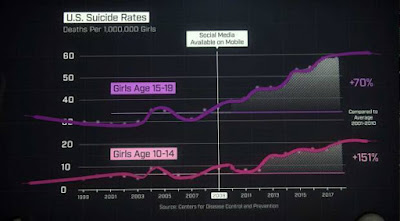
One could argue that Facebook is also such a product. Studies have shown that self-esteem declines among those who are heavy users of Facebook. Teenage suicide rates have increased markedly since the introduction of the smart phone and wide adoption of Facebook and Instagram[1]. The META officers like their products because they can make them addictive while sucking highly personal information from users, and that means higher advertising revenues for META. Perhaps Zuckerberg sees VR as an even more addictive social media. If so, I would worry that it is more like an alcoholic beverage than it is a medicine.
I actually own a few shares of META. It's not much, and so far I'm losing money. I don't see META-based VR as improving the fortunes of its users or of META, and for that reason I have little interest in adding to my position. Normally I would do a discounted cash flow (DCF) analysis of a company in figuring out its long term potential. Unfortunately, tech companies tend to have volatile, short, hard to predict life spans. Will META last five more years before seeing revenues decline? Will they spend all of their profits on VR capex for the next 10 years? At what point would they give up, or would they ride it all the way down to zero? Will it turn out like AOL?
META is already trading at a non-unicorn price. PE of 13.97, at today's price of $178.78. That's not bad, until you see ALLY at PE of 4.6, INTC at 7.4, WBA at 6.6, C at 6.6. Can META grow? Don't they already have 2 billion users? Does the bull case for META involve rooting for people to have more sex and more babies, and a higher total fertility rate (TFR) worldwide?
Teens already spend too much time on Facebook. Just today WSJ published "More Than a Third of U.S. Teens Are on Social Media Almost Constantly, Survey Says". What is the growth rate over "almost constantly"? Is it "constantly" (!!), "while sleeping too", or do we need to rely on increasing Facebook use among prison inmates and finding more undiscovered African and South American tribes?
On the other hand, Facebook and Instagram do seem to addict a lot of people. Look at how that worked for the tobacco companies. All these years later, despite huge price increases and taxes, and the fact that federal, state, and local governments make more money from cigarettes than shareholders do[2], PM, MO, and BTI are still around. Unfortunately for META shareholders, there haven't been enough academic studies that show people dying from use of social media for the liberal hue and cry to go out about shutting down or heavily taxing social media. Fortunately for META shareholders, it is unlikely that such things will come to pass, as liberal sociology academics have normative principles that align with the heaviest user base of social media, which is liberal. It is unlikely that those who lean left will shut down an addictive product most heavily used by the left.
And that bookends the META reality problem quite nicely. Here I will define a "social world" as being one that is held collectively in the minds of a large number of participants. META's infrastructure supports social worlds of this type. The maintenance of a larger, more connected and involved social world is what social media is all about. We've had social worlds since the first clans. Any polity has some aspect of a social world to it. Until 2010, most of our social worlds had to live within physical worlds, and if there was a conflict, usually the physical world won. And in cases where the social world won completely, the precarious physical existence of the polity supporting the social world (e.g., U.S.S.R., East Germany, Mao's China) forced the death or rapid reconfiguration of the "victorious" social world.
Zuckerberg's political style is clearly of this stripe. Perhaps in his mind, collectives can provide better support to a social world when the technology is enhanced. To make something up, he might believe that socialist systems don't fail because of their physical world problems, but because the social worlds built on top of the physical layer wasn't compelling enough.
Said this way, it's obvious that he is constructing a fantasy that is unlikely to hold up. Even when social worlds were held together by single page newspapers, Jane Austen novels, and town marketplaces, they were still vibrant and worthwhile, even though thinly spread. We're richer now by far, but just because we have surplus resources to commit to commentary, outrage, and Like buttons doesn't mean that we make our social worlds richer because of excess.
I think that eventually META will build a virtual world, it will have inhabitants, there will be news articles, and some exciting things will happen there. But it will be like Second Life. It will be like the other Corporate experiments with virtual worlds and virtual meeting spaces, many of which have been attempted and discarded or written off. It will be far less compelling as part of a full life. It will be easily bypassed, too expensive in all sorts of non-monetary ways. There will be injuries, repercussions, and lack of revenue. It will muddle along and be disappointing, but not when you look closely. It will also be exciting when viewed at the small scale, but a distraction when viewed at the scale of civilization.
References
- The CDC data on teen suicide I found only goes to 2015, but the graph is certainly cheerier than the ones Jon Haidt uses, in part because it doesn't go out to 2017, and the 1990s were evidently a very dark period for teen males, who committed suicide five times more often female teens.
- Federal cigarette tax is $1.01 per pack. State taxes vary, with DC, NY, and CT having the highest rates at $5.01, $4.35, and $4.35 per pack respectively.


